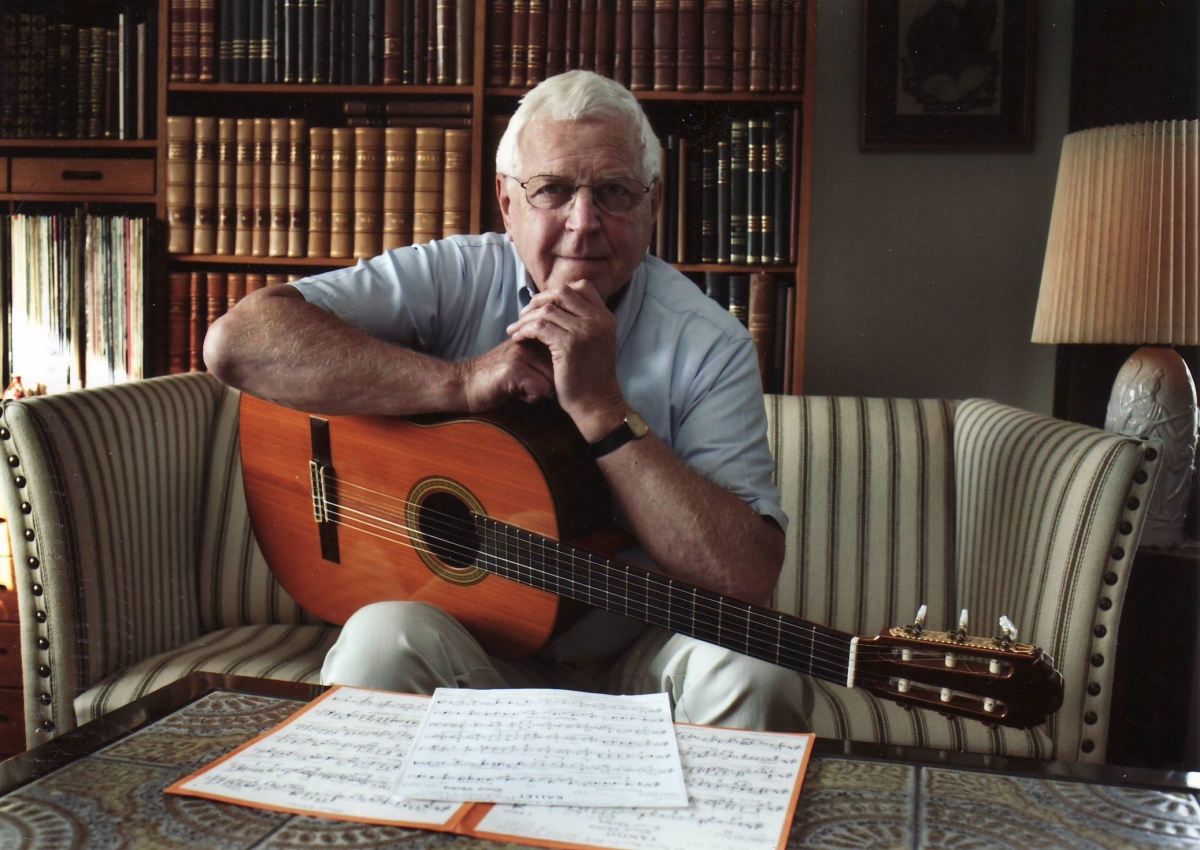
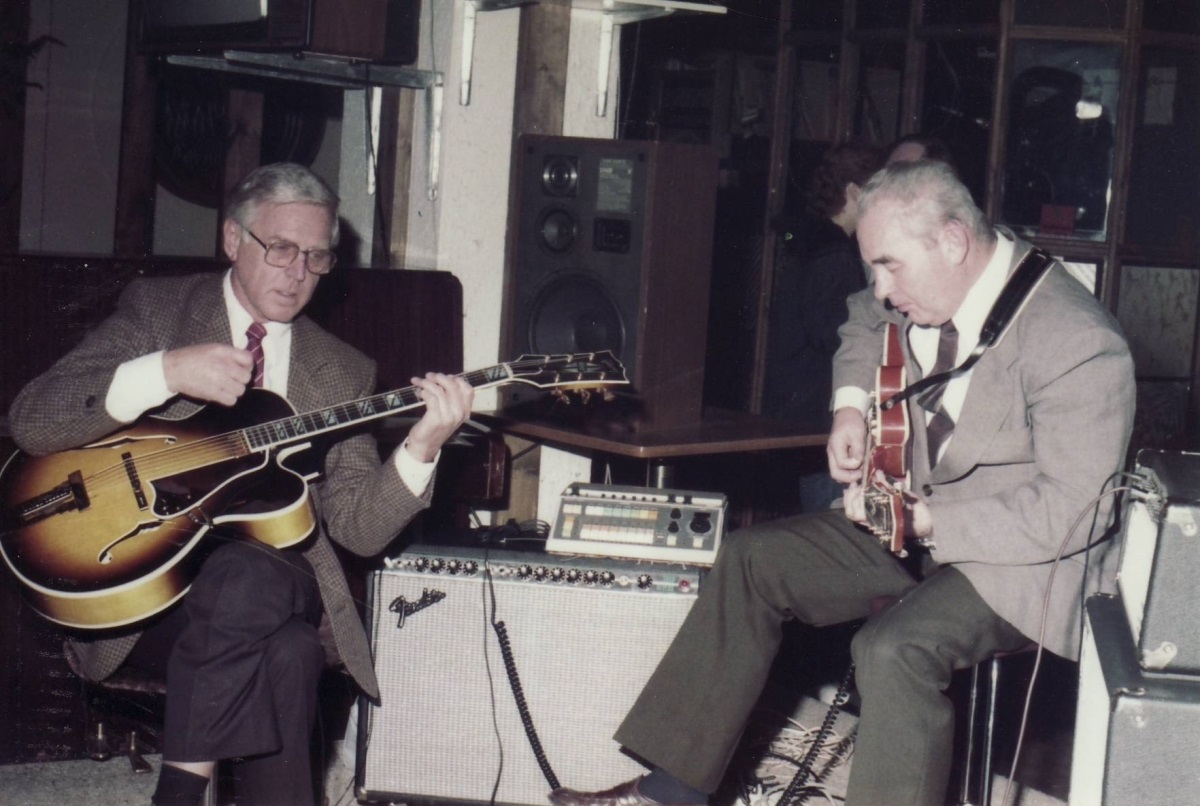
Trausti Thorberg Óskarsson
Trausti Thorberg Óskarsson was born at Brattagata 3 in Grjótaþorp, Reykjavík, on 19 November 1927. He later grew up in his childhood home at Bræðraborgarstígur 16. He received his primary education at Barnaskóli Miðbæjar, near Tjörnin in Reykjavík. At an early age he began working in his parents’ bakery at Laugavegur 5. In 1943, he entered the Industrial School as an apprentice baker.
By this time, however, Trausti had already developed a keen interest in the guitar, dating back to around 1940, and had, among other things, studied with Sigurður Briem. Iceland had then been occupied by the British, and among the servicemen who arrived were musicians who played dance music. It was through them that Trausti first saw and heard the guitar being played as part of a band. From then on, nothing interested him quite as much as rhythm guitar, and he made rapid progress on the instrument.
The Americans subsequently took over the defence of Iceland, bringing with them large orchestras and big bands, in which the guitar was invariably present. By this time Trausti had already begun playing with various musicians, particularly accordionists. There was considerable demand for a capable rhythm guitarist, as dancing was enormously popular in those years.
Eventually, Trausti was given the opportunity to join Þórir Jónsson’s orchestra at Hótel Borg as an apprentice, in order to gain experience playing with wind instruments. This meant that he had to play in keys with which he was completely unfamiliar. For a short time he received instruction from a guitarist stationed in Iceland with the military, Jimmy Webster, who helped him overcome the difficulties involved in playing alongside wind players.
Trausti began playing with the K.K.Sextet in September 1947. It soon became apparent that his ability to read music was extremely limited, while he was now required to play written parts alongside saxophone and trumpet. He found this very difficult and therefore had to learn most of his parts by heart. It is also worth mentioning that throughout these years, while working as a guitarist, Trausti worked as a barber during the daytime.
In 1948 he went to Denmark with his beloved Dóra. She attended a school of home economics, while Trausti worked in a barbershop in Copenhagen. During his time there he became acquainted with many musicians, including the outstanding guitarist Helge Jacobsen and Jørn Grauengaard. Trausti took lessons with Grauengaard that summer, and when he returned to Iceland in 1949 he played with most of the professional musicians active at the time. He worked particularly often with Carl Billich at the Góðtemplarahúsið and performed in more than one hundred performances of Deleríum Búbónis, a play by the brothers Jón Múli and Jónas Árnason.
In November 1946, a Swedish classical guitarist had visited Iceland and given a concert at Tjarnarbíó. It was there that Trausti first encountered at close quarters what he had long been searching for: the guitar played as a solo instrument, using techniques entirely different from those of rhythm guitar. For Trausti, this was something of a revelation.
Then, in the autumn of 1959, Eyþór Þorláksson came to Iceland, and a deep and sincere friendship immediately developed between us, a friendship that has endured to this day. He introduced me to the world of the classical guitar and immediately began guiding me. He gave me sheet music, lent me records—in short, he set me firmly on the path I was to follow.
After this we played together, along with his wife, Sigurbjörg Sveinsdóttir(Didda Sveins), who sang with our trio at Þjóðleikhúskjallarinn and later at Röðull.
Eventually, Eyþór strongly encouraged me to enrol in music school. I was around sixty years old at the time, already grey-haired, and thought it absurd that I should undertake such demanding studies. But Eyþór urged me to do so. My main purpose was to acquire a solid knowledge of music and a better understanding of the guitar repertoire, and perhaps I might even have the makings of a guitar teacher.
I pursued my studies out of a genuine love of music and graduated from the Hafnarfjörður School of Music with a recital on 21 April 1985. While still studying, I had begun teaching at the Mosfellsbær School of Music, and subsequently also taught for many years at the Hafnarfjörður School of Music.
Without Eyþór’s support I would never have made it through my studies. He was a demanding teacher, but a fair one, and I am deeply grateful to him for everything he did for me.
Now I am free to do what I have always wanted to do with the guitar, although now it is solely for myself: for the pleasure of writing for the instrument and hearing the gentle sounds that can be drawn from this wonderful instrument.
On the pages that follow are Icelandic songs arranged to be played as solo works for guitar. Our composers wrote these beautiful melodies to accompany fine poetry, and they have become beloved by the Icelandic people. Many of the melodies can also stand on their own without the words and are often performed in this way, for example on the violin, cello or piano. I felt that it was time for the guitar to take its place among them.
For this to work, the music needs to be played on what is known as the classical guitar. The challenge is to allow the melody to sing clearly, and doing this well requires a certain degree of skill on the instrument.
I have included some fingering suggestions for the pieces, although these may of course be approached differently, as fingering is a very personal matter. As mentioned above, most of these songs were originally composed for solo voice or choir, and the poetry should always be kept in mind when playing them, so that the melody can be expressed as fully as possible.
These arrangements were written over the course of many years and gradually accumulated into the collection presented in this book. My good friend Eyþór Þorláksson, for many years a teacher at the Hafnarfjörður School of Music, has assisted me with various suggestions and advice. In addition, he entered and typeset all of the music for me on computer, for which I am extremely grateful.
I am also deeply grateful to my wife, Dóra Sigfúsdóttir, for her steadfast assistance with the poetry and with everything else connected with this pastime of mine—and not least for her patience. I dedicate this book to her.
Written in September 2008
Trausti Thorberg